
How to Build High-Performing Instagram Stories at Scale (My 7-Rule Framework)

Instagram Stories have become one of my favourite creative playgrounds, not because they’re fast or easy, but because they reveal exactly what a brand really understands about visual communication.
Stories are intimate, immediate, and unforgiving. They expose clutter. They amplify clarity. They reward brands who know how to tell a micro-narrative in 15-second fragments.
After using Stories daily for my own brand and a dozen clients, I’ve developed a workflow that allows you to batch-create weekly Stories, repurpose past content intelligently, and maintain a consistent, elevated aesthetic — without burning creative calories every single day.
I also like to sketch out my planning first, to be able to story board and visualise how to generate interest or take the audience on a mini journey in the stories. It’s not about just blurting our commercial content or posting pictures/video randomly. You need to lead the horse to water, so to speak.
Here’s my 7-rule framework for scaling Instagram Stories like a modern marketing director.
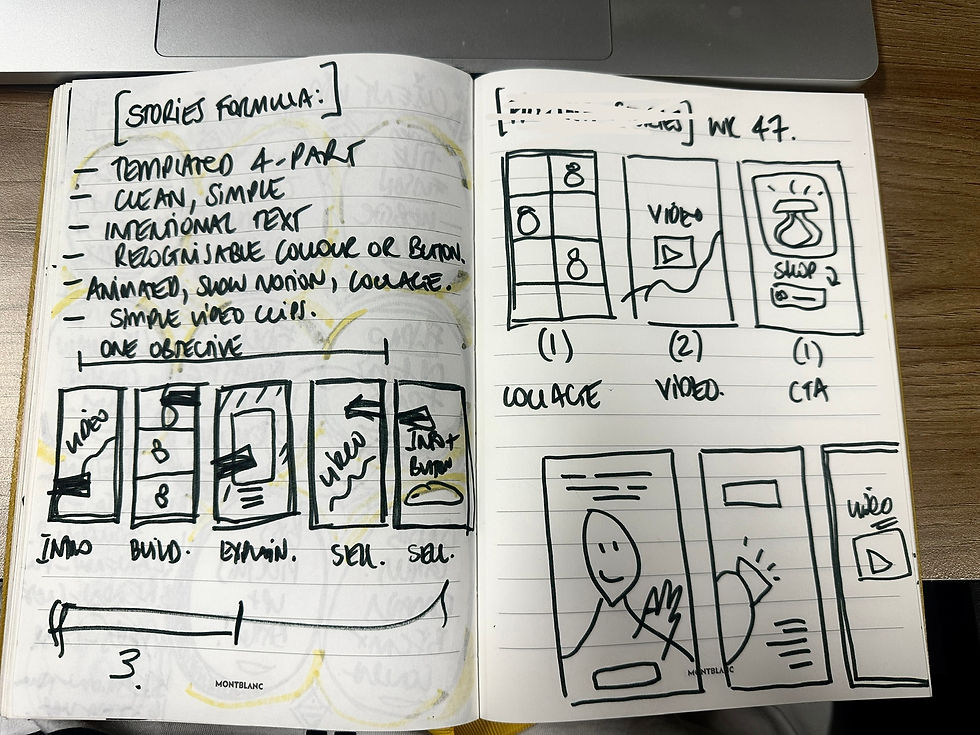
1. Start With a Templated Structure: 3–6 Segments With a Beginning, Middle & End
Stories work best when you create a narrative flow, not a random drop of content.
I always start by mapping out 3–6 frames:
Frame 1 — The Hook Something visually strong, simple, or intriguing. Set the tone.
Frame 2–4 — The Core Message This could be B-roll, screenshots, a value point, a product highlight, or a behind-the-scenes moment.
Frame 5–6 — The CTA or Next Step “Shop the collection,” “Watch the full clip,” “Visit the showroom,” “Save this tip,” etc.
These segments become your template — meaning every week you only need to change the content inside the structure, not reinvent the format from scratch.
This is what allows you to batch-create ahead, slot in fresh material easily, and build story rhythm.
2. Keep Your Layout Clean, Simple & Uncluttered
Clutter is the fastest way to lose someone in 1.5 seconds.
Your goal: visual calm. Your audience should know instantly where to look.
Keep these principles front of mind:
Avoid too many stickers, arrows, GIFs, or competing fonts
Use negative space intentionally
Present one message per frame
Let the imagery breathe
A clean design doesn’t mean boring. It means intentional.
3. If You Use Text, Make It Intentional, Minimal & Legible
If you add text, use it with purpose.
Ask: “Is this text adding meaning or just taking up space?”
Use crisp, high-contrast typography that is easy to read. Short, essential lines only:
“New collection drops Friday”
“Behind the scenes”
“Before & after”
“3 reasons this matters”
Legibility = retention.
4. Use Your Brand Elements Consistently
Stories are not disposable — they are a brand asset.
Your audience should recognise you instantly through:
Signature colours
Consistent fonts
Branded frames or borders
A recurring icon
A signature layout style
Repeated tone or language patterns
This builds memory, familiarity, and ultimately trust. Consistency is how Stories shift from “random posts” to a recognisable visual world.
5. Mix Your Media Types (Video, Imagery, Animation)
Once your core frames are laid out, add texture and variety.
The most engaging Stories blend:
Quick clips of video
Static photos
Screenshot moments (with design clean-up)
Animated elements or transitions
Simple motion graphics
Product stills
B-roll of your environment
This keeps the viewer moving through the narrative without monotony.
6. If You Use Video, Keep It Short, Textural & Purposeful
The best Story videos are simple:
A slow pan across a product
A 0.5-second clip of hands working
A behind-the-scenes walk-through
A moving shadow, light, or detail
A product reveal moment
You’re not trying to shoot a documentary. You’re trying to communicate mood, context, and relevance in micro-bursts.
Shorter clips = higher completion rates.
7. Keep Your Objective Front of Mind
Every frame should earn its place.
Know exactly what you want the viewer to do:
Click through to the new collection
Visit your shopfront
DM for bookings
See a product in context
Learn about a launch
Build connection with your founder
Save a tip
Share the story
Stories with clear objectives convert.Stories without objectives... evaporate.
How to Scale This Weekly: The Batch-Creation Method

Here’s how I personally build a week of Stories in 45–60 minutes:
1. Choose your weekly theme
One focus: a product, an insight, a launch, a client story, a moment behind the scenes.
2. Start with your template (3–6 frames)
Pre-built frames save enormous time.
3. Search your camera roll, drive or archive
Look for:
Clips you haven’t used
Clips you used once but can repurpose
Images you can crop differently
B-roll you forgot existed
Past content is an asset, not a one-time use item.
4. Mix fresh with repurposed
Add one or two new elements to refresh the narrative.
5. Layer in brand elements + CTA
This is where design ties everything together.
6. Export the whole series and save to your Story folder
Ready to post across the week.
###
If you want support developing a custom Story system for your brand — templates, animations, brand kits, or content strategies — The Majors Agency can help you build a framework that scales with your brand.

Comments